Showing posts with label A to Z Blogging Challenge. Show all posts

Tuesday, April 19, 2011

Blogging from A to Z: O is for Opulence

Every player wants the best for his character.  They might not come right out and say it, but in their heads, they are thinking it.  Everybody wants to be rich, but we're not all that lucky.  So, maybe the closest thing we get to true wealth comes through our RPG characters.

Opulence comes when you get to that point of wealth where you can pretty much just stop asking how much things cost.  You've got the money to do whatever you want.  For most RPG characters, true Opulence is something that you're never going to pull off, mostly for reasons of game balance.  When it comes to games like D&D 4e for example, where your GP plays such a huge part in the power of your character, you're very unlikely to ever reach that point of wealth where you can start to gold plate your horses or buy yourself a yacht which comes equipped with a large golf course.  But man, wouldn't that be awesome?  Then again, a lot of D&D characters are going to be rolling in money by the time they hit Epic levels, and, in all honesty, you've probably got enough GP to buy yourself a small country by the time you get there (but still not a full set of 25th level items for all your slots).  That is the very odd fact of wealth in RPG's.  The stuff that has a value to your character, the magic items, etc. are very rarely actually something that screams "opulence".  Instead, Opulence is more often a sign of a character's fluff.  Opulence comes in the story rather than the "crunch".  That works too.

When your players reach that point in their careers that they should start seeing some serious wealth, give it to them.  You can always use factors such as item availability to limit your players ability to pick up more crunch specific magic items.  Let your players have that massive palatial estate which is completely manufactured out of human happiness.  Let them have the gold and the jewels.  That stuff is all just a sign of status and position, something that your characters earn through adventuring.  That is one seriously cool reward.  Let your characters' opulence also be used as a tool, or hook, for starting adventures.  Maybe somebody stole something of incredible personal value to one of your players, or maybe somebody came in and vandalized your PC's crazy cool mansion.  Use those opportunities as a chance to get an awesome adventure under way.

Sunday, April 17, 2011

Blogging from A to Z: N is for "No Mr. Bond, I expect you to die"

got sicker all of a sudden, going back to the hospital in the morning to get checked out.  Here are some funny pics of one of my favorite catch phrases : "No Mr. Bond, I expect you to die."


Saturday, April 16, 2011

Blogging from A to Z: M is for Motivation


Earlier this month, I went over goals, and how you need to manage and keep track of player goals in order to make sure that they are getting what they want out of the game.  I also went over how goals and motivation were two very different things.  Motivation is the reason why you are moving toward a goal.  Motivation is what keeps you moving forward.

Keeping track of your players motivation for gaming is probably the most important thing for building a great gaming group which lasts.  It can be pretty difficult to figure out, if you're playing with people you don't know, but with friends, it could be just as easy as sharing some fun time with your buds.  Figure out what best motivates your players to show up with their A game and you're going to be in very good shape.


Blogging from A to Z: L is for Leveling Up

Well, I'm still sick, but i'm actually walking around again now.  Being bitten alive by killer Mosquitos then practically getting quarantined at the hospital for an hour or so has a very adverse affect on my will and ability to do much of anything but stay in bed and swat away the bugs.  But, now that I'm half alive again, thought I should probably get some of these "Blogging from A to Z" back posts out.  I may be behind, but I still feel like I can catch up.
In my book, L is for one thing, and one thing only: LEVELS!  But, how do levels play into a successful adventure.  Well, when building an adventure, or a campaign, you have to always be aware of the level of your players and the levels of the enemies, at least for the purpose of balance, and making the encounters enjoyable and entertaining for your players (at least this is the accepted train of thought for 4th edition D&D).  However, leveling up is an important thing to think about when you're plotting out a series of encounters.  Knowing when your players are going to level up can make for a very rewarding tool; when you know that your characters are going to "Ding" you can scale up your encounters in advance accordingly.  But, aside from just knowing when your players are going to level, you can be a bit more proactive with it.  Let's face it, you're the DM, if you want your players to level up, then for god sakes level them up.   I haven't had a lot of postive experience playing games at the lowest levels.  That may just be my experience, but I prefer my characters to be pretty damn powerful.  I think the same applies to most video games as well.  In World of Warcraft you don't see players sitting around at the low levels on purpose very often.  More often than not, players are going to power level as fast as they can in order to get to the top tier of the game where they can do some really, really epic stuff.  
Power leveling is not really a component of most pen and paper RPG's, but there is of course a way to get around that.  Power leveling is not in the hands of the players, it is is in the hands of the DM.  Forcing a level jump, in which players skip several levels in order to get to a greater power point is a very easy way of mimicking the "power leveling" process.  There are lots of ways to explain that story-wise; maybe the players take a break from adventuring to dedicate themselves to further training in order to hone their skills and develop new abilities.  Maybe the players down something so incredibly awesome, or fulfill the end goal of a quest so epic, that they immediately go through a big jump in power.  Go crazy.  Just remember, if your players aren't interested in leveling up quickly, or would like to simply level their character though the natural organic process of killing monsters and looting their treasure, then let them.  Don't get in the way of their fun.  But, if they show interest in skipping the entire 1-20 and simply getting on with their really, really epic destiny than skip all the stuff in the middle and just go right there. 


Wednesday, April 13, 2011

Blogging from A to Z: K is for Kill and Loot


I remain ill and unable to really put my heart into this anymore.  Being laid up sucks.  Today, I simply ask you this.  Kill and Loot, the primary methodology that you get out of most D&D, does it get old to you? I'm not sure, but I think I'm looking for something more lately.  Maybe reading through the Leverage RPG, or hearing stories about some dude who maxed out his level on World of Warcraft without killing anything, but I'm really interested in playing some straight up group story-telling.  Who's with me?

Tuesday, April 12, 2011

Blogging from A to Z: J is for Japan

Well, I thought I'd take one out of my 26 posts this month to just write a bit about Japan.  Hell, it does start with the letter J after all.  Things here are incredibly crazy still.  Some reports are saying that casualties from the quake have caused the deaths of over 15,000 people and an estimated 28,000 may have died in the Tsunami.  I believe the last I heard, several hundred thousand of people have been directly affected by the quake i.e. have had to be relocated or are now homeless.  The relief efforts are continuing though; several hundred million dollars have been raised for Japan relief - my wife mentioned to me that the CEO of Softbank (my phone company) has donated over 100 million dollars to the relief efforts and is donating his entire monthly paycheck every month in addition.   There are lots of reports, from people, all over the world, talking about how much people have come out to help.  The guys responsible for TF2 have donated almost half a million dollars, and the RPG community has come out in massive support.  This week on Kev n' Jen's "Plus One" podcast, they talked about how tragedies like this have the power to showcase the good in people.  That's definitely true.  The disaster has shown how great people can be.  But, nothing is over.  There are still quakes happening every day; yesterday a massive quake around 7.1 or so, hit Fukushima, causing temporary loss of ability to poor water on the reactors because the power went out (though I believe that got fixed) and another quake this morning in Chiba had people rattled as well.  We got hit by another one today, while I was sitting eating lunch (actually just a cookie) and that had some of the teachers quite spooked as well.  Some people are saying that it might be years until the plates calm down and these quakes stop.  Going to be a rough time for the Japanese people.

I don't want to go on too long, mostly because I'm still pretty sick and trying to get some rest, but I wanted to take a little bit of time out to applaud the efforts of all the people who are giving what they can to support the relief effort here.  You are making a huge difference.  The people here need as much as they can get; my wife was telling me something she heard on the news: despite the fact that hundreds of millions has been donated, after that has been divided up between all the people who have lost their homes and loved ones in the quake, the tsunami, and the aftermath, every person will only get about $3000 dollars of it.  That is to make up for the jobs, homes, and family that they lost.  They are going to have to make do on what amounts to only a single month's paycheck in whatever effort they try to make at rebuilding.  They really, really need all the help that they can get.

Thanks people! Keep up the good work.  Japan sends its thanks!!

Monday, April 11, 2011

Blogging from A to Z: I is for Ingenuity


Every good adventure needs some good ingenuity on the side of the adventure builder.  Make sure to encourage ingenuity in your players so that they can find creative solutions to perhaps mundane problems.  Ingenuity is also pretty much the key you need to homebrew and house rule stuff on the spot.  Find your ingenious side and nurture it :)


Again, sorry for the weaksauce post.  Still pretty sick.  Regular posts will resume after recovery.

Saturday, April 9, 2011

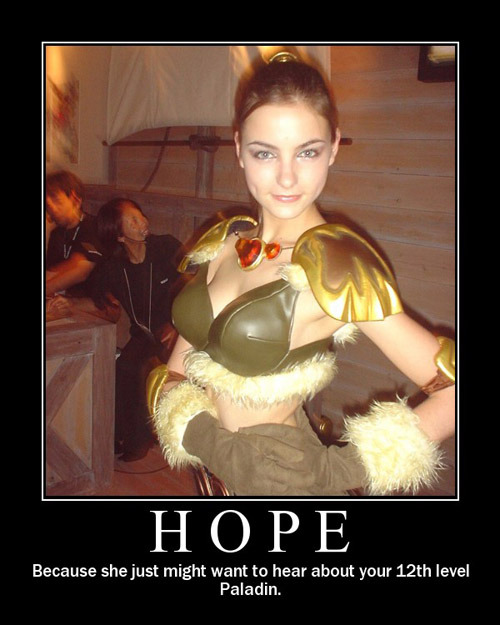
Blogging from A to Z: H is for Hope


Every player and every DM needs hope.  Hope is essential for both character and NPC's alike.  Do you have hope?  Without hope, you're pretty much doomed in the RPG world.  NPC's who are hopeless will turn to extreme measures in order to get hope back.  Try to take advantage of that as a plot device in your adventures in order to turn good NPC's temporarily evil, and thus give your players that pesky moral choice dilemma when they have to decide whether to kill or just maim said NPC (they'll most likely kill him if it that NPC doesn't really seem to matter).  If your players do kill the innocent NPC who has turned to dark side in order to regain his or her lost hope, lay the alignment smackdown on your NPC's and make them live up to that evil decision of theirs.


I also hope that I will be better the day after tomorrow so that I can do a better post for the letter I.

Thursday, April 7, 2011

Blogging from A to Z: G is for Gallons of Goals

Today, we're going to talk about the multi-faceted, and supremely important letter "G" (it's the most important letter of the alphabet... not because my name is Greg...).  G is for goals, and goals are arguably one of the most important things you need to take into consideration whenever you're playing an RPG.  That statement applies just as much in the game, and in character, as to out of the game, and the goals your friends have for coming to play an RPG with you.  Better get to know yours and your friends goals.

There are several different kinds of goals, which are relevant to our collective interests.  Today, I want to talk about a number of these: Player, Adventure, PC, DM, and NPC goals, are all important to understand when trying to figure out how to properly construct an adventure.

Before we start in on that however, I think it's important that we first define and understand the difference between "goals" and motivation, because there is a difference, though it may be subtle.  Goals are the end result to which effort is directed.  Motivation is the reason for striving toward that goal.  Keep that in mind as we take a look at the various types of Goals that are relevant to playing RPG's and designing a good adventure.


Player Goals
What is the players goal for playing an RPG?  That's a good question.  What are you trying to achieve by getting out your polyhedral dice, sitting around a table with some friends, a mountain dew or a beer, and probably a pizza (or some other type of party food)? WHAT DO YOU WANT?!  Well, for most people, the end goal at the end of a gaming night is pretty simple: you're trying to have fun! FUN!!!!  Many players may set their goal, unconsciously, that they want to get together with a bunch of friends and enjoy the roleplaying experience for an evening, or a series of evenings, for a campaign.  Pretty simple right?  Well, yea.  The only problem really arises when one or two people have a different goal.  Maybe someone's goal isn't really go come Roleplay, but their goal is to come to the game to mooch free food off of the GM, or to get drunk at some friend's house who is deemed to be "trustworthy" by high school parents.  For most people, you're not going to have too many problems with goals conflicting at the game table because let's face it, you have all got together to play a roleplaying game.  However, you might have problems with conflicting motivations.  Some people might be motivated to play RPG's for the tactical combat, some might be motivated to play because of the chance to roleplay.  This difference in motivation is much more likely to cause conflict and thus prevent everyone from achieving their shared goal of enjoying an evening of RPG's (and beer... or Mountain Dew).

So that problems like these don't happen, it's really best to sit down with everyone before the game starts just to make sure everyone is on the same page.  If everyone understands each other, you're not likely to get into problems later down the road.

You might find that my definition of player goals differs from what you think of when you think about that topic.  I tend to think of player goals as things that go on outside of the game and are not connected to any PC or, in fact, to any actual single game that you might be playing.  Check out PC goals below for what I think about goals for player characters.

Adventure Goals

Well, since this month, I'm trying to focus somewhat on adventures with this whole Blogging from A to Z thing, I would be grossly remiss in not talking about Adventure Goals.  What is an adventure goal? Perhaps the goal of a short adventure is getting the kidnapped princess out of the hands of the evil dragon turtle who kidnapped her from her castle.  Maybe the adventure goal is to enter the planes of chaos and destroy one of the demon lords who rules there.  If you're playing with the same people all the time, make sure to change it; don't always go back to the same adventure goal.  People get tired of:
1) enter dungeon 
2) kill all creatures inside 
3) retrieve loot 
4)???
5) profit. 

You're going to have to do better than that.


There is a big difference between a short adventure goal, which might only take a couple sessions to achieve and a longer campaign goal which has much more widespread connotations, but regardless, always try to aim high with the goal.  If your players are able to reach that awesome adventure goal, they will be able to brag about it and will remember it; if they don't, which is entirely a possibility, now you have the seed for the next adventure.  For example, if your players need to prevent a Lich from resurrecting through the use of its phylactery, but fail, than you have a great new goal for the next adventure.  Fun!!

PC Goals
Player Characters are going to have the most varied types of goals and will probably have a lot of them.  PC goals are also the most complicated because they can come in a variety of types and time frames and you, as a GM, are going to have to make sure that you know all of these goals so that you can help your players to reach them.

PC goals can be both short, and long term.  A Short term goal might be something like getting to use the awesome new magic item, that the character just got, in a useful way, sometime during the next encounter.  A long term PC goal might be something like gaining several levels in order to gain that awesome class feature that you've been waiting for.  PC goals can really range in time frame anywhere from a single session, to multiple years, so it can be pretty hard to keep track of that kind of thing.

Player goals also fall into two other distinct categories: mechanical and story.  Mechanical goals are character options, whether that be some XP, a level, a new item, some gold, etc. which will have an impact on their character in the mechanical sense.  Story goals are goals that have to deal with the role your character has played in the world.  Perhaps a Cleric NPC wants to grow up to be a saint.  That's a pretty hefty, and awesome, long term goal.

As the DM, you might want to use some type of record sheet in order to keep track of all of your PC goals.  On the sheet, make tables like you would see in the D&D 4e books for Weapons.  Mark Down the player name, where you would see Simple weapons, and then for each category of goal, i.e. Short Term-Mechanical, Short Term-Story, Long Term-Mechanical, Long Term-Story, have your player write down a few of his or her goals, or, if you hear him talking about something that he would like for his character, just go ahead and mark it down yourself.  (I'll probably get around to making a table for that at some point and post it up here... unless TheWeem gets there first ;)  he always makes the coolest accessories, loving the Fate Point Cards).

Manage your players expectations while trying to help them reach the goals that you have recorded.  If you can work those goals into the adventure in some way, than you're on the right track.  You should, however, work your way through the group, rather than focusing on one person too much.  If one person's story ends up having more importance to the larger side of the plot, make sure to take time out to have small, side-trek adventures that will showcase your less focused on PC's and allow them to achieve their story based goals.

DM
As the DM, you have one goal, make the game fun for everybody involved.  You may have some goals, such as showcasing a really cool monster that you put together, or showcasing some cool world element that you made in your copious spare time, or you might have something even loftier, like having your players experience the awesome linear adventure you just got finished writing... but, if your goal ever comes into conflict with your players goals, to the point where they are losing interest in your adventures, you need to put those goals aside and refocus.  You're kind of like the host of the party, that means you might not have a fun time setting up, or cleaning up, but if you stay in control, and pay attention to your party guests, and their needs, they are going to have a great time and come back for the next party.  If your players are happy, they will let you take chances and try to have some fun of your own.


NPC Goals
This might be a silly thing to mention, since I've just spent all this time talking about having goals, but it's worth mentioning that your NPC's should all have goals as well.  Perhaps you don't really need to write them all down, but keep it in mind.  For an NPC, a single goal is probably all you ever need, unless that character is going to show up A LOT!  A random Baker NPC's goal is probably just to sell bread after all.  He doesn't need some crazy back-story.  An NPC assassin might just have the goal of killing player X or NPC Y.  He or she might not need a lot of other complicated goals, though a character like that probably needs to have some motivation that will make that character interesting to interact with for the players.

Well, that was a pretty long post, and I'm a bit exhausted from writing it, but I will say, I'm really happy with how this is coming along so far.  My goal for this month is to write 26 of 26 posts for the Blogging from A to Z challenge and to do them all on time.  Also, if possible, I want to have a motivational/demotivational poster in every single one of them because A) They are awesome and funny and B) I find that I need the motivation to keep doing this because it is dang hard.

See ya'll tomorrow!!

Wednesday, April 6, 2011

Blogging from A to Z: F is for Freedom

I think that one of the most important things to making your adventure really, really fun and successful is by giving the players freedom.  I of course do not mean true freedom, but a sense of freedom at least.

No player likes to be railroaded.  This is true.  Unless you go into a game with everybody on exactly the same page about the game that they are going to play, you're not going to have many players who are begging to go on a completely pre-planned, pre-plotted linear adventure which works like a Dungeon Delve without any diversion from the single path leading from the entrance to the boss battle.  Nobody really wants to play those adventures if they are given a choice between the open, free adventure, and the railroad.  Sometimes you are forced to do one of them, because the DM has been slacking off on the job and doesn't having anything particularly fascinating prepared for the players (an experienced DM wouldn't let that stop him though... bust out those Random Tables man!).

But, I postulate (ooo big words) that even in the face of no preperation and the use of a published linear adventure, that a smart DM can still give his players the illusion of Freedom if he or she simply has the spine to try.  Sometimes, as a DM, you have a plot/story in your head that you really, really want your players to follow.

Taking Freedom away from your players is all about the illusion.  The better the illusion, the less they will feel that they have been violated in some way, or tricked by the DM.  You have to to play things cool.  Giving them two paths, like the illustration to the left, if a good way to get your players to call fowl on you, but put those paths a bit further apart, make them wind a lot more, and you're likely to have things work out just find.

Take for example adventure hooks; adventure hooks are a great way of creating the illusion of freedom of choice.  When you, as a DM, have a story that absolutely has to be told, and an adventure that you absolutely have to send your players on, prepare bucket loads of adventure hooks of all different kinds.   However, the trick to making really good adventure hooks is to keep them from all looking the same.  Don't simply throw the same hook, but with a different NPC/reward attached in front of the players over and over again.  Make the adventure hooks look significantly different from eachother, but the end result always sends them on the same grand adventure.  If you can master that, you're well on your way to being a fantastic DM.  I still haven't gotten that down, but I've been working on it.  A lot of my games still tend to feel a bit rail-roadish, but my players usually forgive me because they're really nice.  They see the fact that their freedom of choice is an illusion, but they're cool people who don't mind being led around.

Tuesday, April 5, 2011

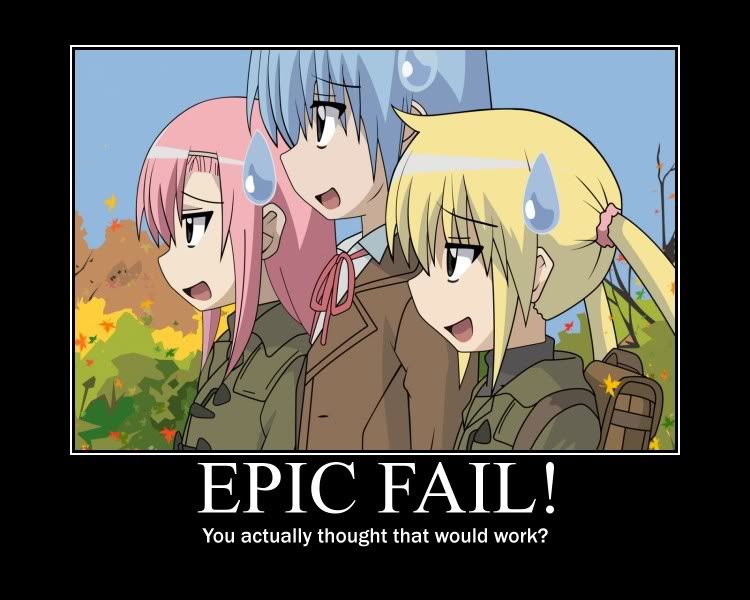
E is for Epic... Epic Fail!!!

Today, for the Blogging from A to Z in April Challenge, I am here to talk about Epic, brought to you by the letter "E".  In RPG terms, especially D&D, Epic is used to denote the highest levels of a campaign, or adventure.  If you have played Epic D&D, especially in 3rd and 4th Edition, you know that this type of roleplaying puts your characters into such crazy high levels of power that they are fighting demons, dragons, and devils for breakfast.  Epic is the territory of the gods and it's pretty good from the top.

But, you know, Epic is something so far out of reach for most people, that I really don't want to focus on providing advice to people who are interested in running Epic Tier 4th Edition D&D games.  If you are interested, or looking for advice on that, you can get it elsewhere.  Let me direct you to Sly Flourish.  He has written an entire book about running Epic Tier games.  I haven't gotten a chance to read the book yet, but I'd really like to.

 What I do want to talk about today is the use of Epic in conjunction with my favorite internet popularized term, FAIL!!  In this case, Epic is used to mean "Impressively Great!" or "Of unusally great size or extent."  We can also use Epic with the word Win, for the combined, "Epic Win".  Now, let's take a break so we are all on the same page in terms of understanding the meaning of these terms.


Wasn't that lovely. I thought it would be easier to show that rather than simply try to explain what all of that means.  But, what does this mean for you and your RPG adventures?  Am I getting completely off track from my goal of providing advice for adventures??

Nope.

I think, that in every adventure you run, you need to leave enough room for their to be an Epic Fail once in a while.  Honestly, Epic failures of players are some of the most memorable things that you will ever see in RPG's.  Really, anything that stands out as being memorable to your players is a good thing.  Maybe you're familiar with the phrase "any publicity is good publicity" well, I think that kind of applies to this situation, but from a slightly twisted angle.  If your player digs himself a hole, or rolls so badly that it ends in an Epic Fail situation, than that player will absolutely remember that situation, and probably won't think badly of you, the DM, because of it.  Sure, that Epic Failure might result in character death, but, hell, it's a game right?  Sometimes, if the dice just roll all 1's, maybe that character really is destined to die.  Better let the dice gods win.

Now, don't assume that I am saying you should outright encourage your players to fail so that they will remember your games, but give them the opportunity to fail in creative and horrible ways so that those fails wills be EPIC enough that they remember them.  A great way to make this possible is through the creative use of random tables.  You might be familiar with Critical Hit and Fumble Charts; many RPG's don't integrate these directly into the rules, as is the case with 3rd and 4th edition D&D, but most gamers have their own house rules for how to use these charts in a home game.  Check out this article on Critical Hits and Fumbles and you can get a pretty good idea of how you might be able to incorporate these kind of rules into your game.

I'm a big advocate of even going beyond just critical hit and fumble charts by using items that generate random  effects.  You might be familiar with the Deck of Many Things (who am I kidding, of course you are familiar with it) or the Wand of Wonders.  These old school items have their roots way back in D&D and are seeing a lot more focus now that the D&D encounters series is putting them into the foreground of the hobby again.  Items like this are just made of Epic Fail/Win.  They can generate some really, really awesome results.  Chances are, if players remember the Epic Fail that occurred in a specific adventure, they will remember the adventure a lot better.  You might have heard R.A. Salvatore recount his Wubba Wubba story regarding his experience with the Wand of Wonders. If you haven't, go listen to it.  If that isn't a great example of EPIC Fail, I don't know what is. (the audio on that video is only so-so, there is a better version available on the WotC podcast, but I'm not sure exactly which one it was... too long ago. Regardless, check it out.)


Monday, April 4, 2011

D is for Delightfully Dark and Dreary Dungeons of Doom... and Dragons

(whew alliteration is rough)

Well, D is a pretty important letter in this world of ours.  Hell, the entire RPG world was built on two very important D's:  Dungeons and Dragons.  Sorry, couldn't help but dedicate this day of the Blogging from A to Z Challenge to these two important aspects in roleplaying.  But, I'm not going to go on about history (mainly because I'm an uneducated swine who has only recently begun his study of the game's roots).  Today, I want to focus on how I think you should use these two elements in your Adventure to the end result of great victory.

Dungeons
While Dungeons can of course just be places for evil wiards to hang out and store all of their magical goodies, a Dungeon can really be any type of closed, designated area, that you want to let your players explore.  There are lots of different ways to build a Dungeon, but, I'm probably the last one who should be writing an article about that, mainly because I rarely ever build a dungeons for myself.  I did however do a little bit of hunting and have found some resources which might prove useful to you in your quest to make dungeons fun and interesting in your adventure.

Building a Better RPG Dungeon

RPG Design: Building the Perfect Dungeon

There are lots of great inspirational resources out there.  For example, the One Page Dungeon Contest is a great place to get loads of cool dungeons that you can use as short adventure "side treks" between the core path of your campaign.  Given my post yesterday, in relation to this month being National Cartography Month, it might be a good time for you to sit down and draw up some cool dungeons to put on display, or to use in your games.

Dragons
I'm a big proponent of using Dragons in games.  Not just a little bit, but a lot a bit.  Dragons are fun and exciting and make for not only great BBEG's, but also can sometimes make for some really, really great henchmen.  Sometimes, at lower levels, I will use Dragons as henchman for more powerful enemies that are still to awesome to show up yet in the story of the adventure.  This usually works out pretty well, especially in games featuring players new to the game, who don't really understand, and aren't really prepared to take on more powerful, challenging and tactical fights (this is coming from my experiences DM'ing 3rd and 4th Edition D&D).

Considering the wealth of Dragon breads out there, you can go through an entire adventure and never make the party face the same species of dragon twice.  Purple Dragons are some of my personal favorites, but the all powerful Red Dragons are a general crowd pleaser at the game table.  Don't be afraid to make entire campaigns set around Dragons in the world either.  There is a reason these baddies have been around for so long.  They can fit perfectly into that final End Boss roll.  Take them for a spin once in a while and let your adventures thank you for it.

Oh... on a side note, Dragon Chow Dice Bags are awesome and you should really check out the DragonAge RPG and DragonAge Legends, the facebook game.  I reviewed it and I loved it. I need more friends to play with, so make a character and start leveling up, you're already behind...  C'MON!!!

OK.  That's enough for today, come back tomorrow.  Please!

Sunday, April 3, 2011

C is for Choices, too many of them...

Today, I had a hard time thinning things down to one topic.  There were simply too many choices for a blog entry that started with the letter "C", so I wanted to actually talk about 3!  WOW!! So, here we go.

Cartography
I would be amiss to forget the fact that this month, Dyson Logos, of A Character for Every Game, is hosting the RPG Blog Carnival.  This month's topic is, as you guest it, about Circuses... jk.  It's about Cartography, i.e. Map Making.  I'm way amateur at it, but Dyson is a pro! If you haven't used/seen his geomorphs yet, you're doing the internet wrong!!!

I really like his blog, and he's always kind of enough to drop me a comment once in a while.  I had promised to do an adventure, or an encounter, or something with some of his Geomorphs and I think that this month, I am finally going to get around to it, given that Cartography is our Topic of choice this month.

If you are looking for some cool maps for your game, or some tips on how to make maps, I definitely recommend you checking out the Cartographer's Guild.  I'm a member on their forums and they have some great tips for improving your mapping skills, especially the digital ones.  I troll that forum more than I post there, but it is definitely a great resource for GM's.


Common Sense
Considering my goal for this month of providing information relevant to improving your adventures, I think one of the most important things to always consider, when playing any RPG is the idea of "Common Sense" and what that actually entails.

I particularly like this motivational poster.  There are so many people that complain about how their campaigns get ruined by stupid people that act in ridiculous ways just because they are playing a RPG.  I think a lot of GM's maybe approach this the wrong way; sure, some players might be persistent, but in every game that I have every played, whenever a player comes up and spits out some line about how he is going to stab NPC X and take all of his stuff, I, as a GM, quickly use my "Common Sense" assume this fool is simply screwing about, and then /ignore him in real life.  Said players actions in the game are quickly ignored and passed over as he/she is quickly considered to be disrespectful and daft git in the real world.  Nobody likes playing with that guy.  What is also pretty nice is that if you use your common sense as a GM when dealing with these jerks, they will quickly tire of being ignored (since all they were trying to do in the first place is get attention) and then use their common sense in the game.  They will cease to be disruptive and you can move on with the bloody adventure.  OK.  Rant over.  Common sense rules people.  Use it.

Can and Cannot
This ties, to some extent, in with the above, Common Sense, advice.  There are some things that you can do in the game and there are some things that you cannot do in the game.   As a DM, running an adventure, really become familiar with what your personal guidelines for Can and Cannot is.

If you aren't interested in reading the following i.e. TLDR - If it's fun = Can ; If it's not fun = Cannot.

Ok.  Explanation.

If something adds fun to the game for everyone at the table, including you as the GM, that to me is an automatic can.  You should go and give your players everything they want, in game one, of course, but for example, if all the players came to me and said that they wanted to start with one additional feet at level 1, when we were playing D&D 4e, I would have no problem with that.  Everyone is on the same playing field and I can up the difficulty level of the opponents accordingly.  Everyone has a right old fun time.

Another example.  If someone says that they want to re-skin (change the thematic elements) X of a race/class/power/etc. in order to make their character into Y, but aren't really interested in changing anything mechanical, I will almost always say "YES!" to that.  This kind of thematic change shows that a player is taking special interest in the story and flavor of his character and is dedicated to making the game lost lasting.  These are the kind of players you really want to have.

However, on the flip side of the last example, if a different player said he or she wanted to change Rule Z so that he was an ever-living bad mother $%&$%&#R than I would almost definitely tell that person that he or she cannot do that because it would spoil everybody's sense of fairness and fun.  Thematically, virtually anything can be explained through the use of good story telling, but you can't explain away the feeling a group of players get when they have just had their adventure ruined by some jerk who insisted on playing a Beholder, got the permission of the GM, and then death rayed all the enemies without the rest of the group getting to have any fun.

I hope that my 3 C's today have proved interesting.  Go, Game and Prosper!!

Friday, April 1, 2011

B is for BBEG (Big Bad Evil Guy)

Continuing our Blogging from A to Z challenge.  Today, is day 2, which means that brings us to the letter B.  I can't think of anything more important to an adventure, or a character's story, than the BBEG.

The Big Bad Evil Guy is pretty much the reason that the adventure exists (unless your characters are just plodding around some open world and not really fighting anybody... who wants to play one of those game?? :P )

Every good Adventure, whether that adventure spans only a few levels, or if it spans the entire life of a character, needs to have a strong BBEG to keep the story interesting and create tension and action for the players.  A BBEG should be a complicated character, with an intriguing story, but the BBEG also needs to be able to kick some serious hind-quarters.  However, the BBEG shouldn't be someone right there in front of the players.  They need to be in the background, an ever looming threat, which finally shows up at the very end of the story and bring the smackdown to the players (who invariably return that smackdown obliterating said BBEG).

There are a lot of great BBEG's out there to draw inspiration from in movies, books, or gaming sources.  I want to talk about two different types of BBEG's, inspired by a film created a long time ago in a galaxy far, far, away.  I want to go over a few of the interesting differences between them.

The Emperor type BBEG

Sure, maybe the more recent Star Wars Trilogy wasn't that great (lots of hate out there), but I will admit, I really liked the way the Emperor rose to power throughout that trilogy.  It was great, seeing the bad guy right in the middle of all major action in the world.  Everybody in the audience knows this guy is as evil as it comes and is going to become the biggest bad-guy in the universe.

The Emperor type BBEG starts off as a subtle villain. He might even appear as a friend to the heroes of the story, but in the end, when it finally comes out that the players have been trolled by the bad guy, things start to seriously go awry and the players have to contend with a horribly evil power broker who wields massive influence and commands the loyalty of millions of evil little pawns.  This BBEG is all about working in the background.  The heroes have to go up against him every bleeding day, but they might not ever get to actually lay eyes on him until the final act.

Using an Emperor Type BBEG is a great way to develop an awesome adventure.  The only problem with this type of character though is the players are probably going to see it coming.  This type of BBEG is used so often in fiction and gaming that people are going to "game" the story, thinking in the meta, and try to figure out who the real bad guy actually is.  The way to fight this: be even more subtle about it.  Make the players think that even though the King is helping you all out, something about him seems to be a little off; maybe they will game it and come to the conclusion that he's actually the bad guy.  Then, when the players have pretty much made up their minds, throw them a curve ball.  It wasn't the king, it was Princess Peach all along!!

The Darth Vader type BBEG 

There are a lot of different ways to look at Vader, THE BOSS, as a BBEG.  I like to think that this type of BBEG is a lot less subtle.  He shows up more often in person than from behind the scenes.  He's a bad, bad man and he wants to be right out there in the open flaunting his power and strength.  Vader type BBEG's work great as recurring villains who constantly show up to thwart and generally despoil the characters, their families, and their friends.

But the Vader type BBEG also has a very involved story.  He's not a simple, one-shade of Evil.  He's many, many shades and one of them just might be good.  He might be really, horribly awful, but with the right motivation, and the proper persuasion, he might be finally turned to the forces of light in the final hour when the players are faced up against somebody even more evil than he is (see Emperor type BBEG for an example of one such "more" evil BBEG's).

There are plenty of other BBEG types out there.  Try to change it up when you're developing your adventure. Try not to get repetitive.  If you constantly abuse the same BBEG type your adventures are going to get stale. Hope that this BBEG advice has been helpful.  Adventure On!

Thursday, March 31, 2011

Blogging from A to Z: A is for Adventure Awaits

Well, it might not be April where you live, but here in Japan, I am right now dead smack in the middle of April 1st.  It's April Fool Day here, though nobody knows what the hell that is.  In Japan April 1st is actually the first day of the Economic Year.  It is the day of the year that all new Jobs begin - today, all the new teachers joined my school and we are gradually finding out who will be teaching what and where we will all be moving our desks too (I got moved next to the couch :P  ).  In Japan, April 1st i a day of beginning.  Oh... wait.  I forget, April 1st is also the first day of the Blogging from A to Z in April Challenge which has been kicked off by Tossing it Out.

Today, is the first day of the challenge; for some of you it hasn't yet started, but like some other people have mentioned, here in Japan, April is already well under way.  So, that means that it's time for me to start; I really don't want to get left behind, that would be like being late for school on the first day and we can't have that now can we.

When I was mind-storming all the different ways that I could possibly attack the A to Z Blogging Challenge, I tried to think up some fun, unique ideas which would set me apart from the other folks Blogging this challenge.  At one point, I had considered doing some new Homebrew every day, earlier this week I had even gone as far as to consider writing an entire campaign starting off with an Encounter on an Airship...

Well, now that the day has finally come, I decided that what I want to talk about is...

ADVENTURE!


It's really kind of a coincidence that Adventure just happens to start with the letter A... I wasn't really planning that.  Adventure is pretty much the spirit of every RPG out there.  Whether you're a Superhero, Crime-Fighter, Cyber Hacker, Warrior, Rogue, or Mage, you are living the Adventure lifestyle.  You don't play RPG's to have your character sit on a farm and watch the grass grow! You play RPG's to experience things that you wouldn't experience in real life, things you couldn't experience in real life, because if you did, you would probably get tossed in Jail for acting like a bloody loony.

Adventures are the stories that every RPG character and player experiences over the life of the game.  Whether that experience is 90% role-playing, or 90% roll-playing, your adventure is your story.  You want to get the best out of that experience right?

This month, I am going to focus about RPG's and adventures.  Basically, I am going to be writing about how to make your character's story, your group's adventure, the best that it can be.  I decided that I want to tackle this subject from a variety of angles:  I might add make an encounter or two, I might write some advice columns, I might develop some tables, or I might just write about my personal experiences.  You never know what's going to come up this month, but I can guarantee that it'll be interesting.  I hope you stay tuned and enjoy!

BLOGGING FROM A TO Z BEGINS NOW!!!!  -/warcry

Wednesday, March 30, 2011

Gearing up for A to Z in April the madness begins on Friday

Well, the Title for this Post pretty much says it all.  April 1st is quickly approaching and that means that the A to Z in April Blogging Challenge will be starting soon.  It's not too late to sign up if you're interested in challenging yourself to this task.  I recommend it.  I think it is going to be a hoot.  Apparently there are over 700 people signed up for the challenge now and it's looking like they might even make it to 800 before the month starts off.  There are quite a few RPG Bloggers out there who have decided to give it a try and I'm really happy to be one of them.

Now, starting later today, I'm going to be knee deep in notes for this; I went through a bit of a change in strategy.  I don't want to say exactly what I'm going to do yet because: 1) I want to keep it a surprise and 2) I might change my mind again and that would just be poor form.

To all those participating.  GL HF.  Let the Marathon of Blogging Commence on Friday.

Monday, March 14, 2011

Guest Post about The RPG Blogger Community @ Tossing it Out

I was recently contacted by Arlee, the writer of the Blog Tossing It Out, the host for the A to Z Blogging Challenge.  He let me know that there were a lot of folks from the RPG Blogger Community which have been showing up for the challenge this year, I being among them.  He let me know that there was a spot open on his blog and was wondering if I would put together a little blog post about my experiences in gaming, but also, about the RPG Blogger community and our world.  I jumped at the chance and was happy to do it.  So, today, If you go over and check out Arlee's blog, Tossing it Out, you will find my Guest Post: Intro to the RPG Blogger Community.  I hope I did a good job representing as much of our community as possible.  I tried to keep it universal.  If you have something you'd like to add, I urge you to comment on the post and throw in your 2 cents.   Thanks everyone who provided me with some ideas for the post and helped me put it together.  Hopefully, this might bring some new readers and a new audience to our community of gamers.