
Showing posts with label Video Games. Show all posts
Showing posts with label Video Games. Show all posts
Friday, March 11, 2011
Gaming with Chopsticks #2 - Why I'll Never Tire of Sequels

Where the Hell Are We? - Fallout 3, One Page Dungeons, Sandbox World Design
Yesterday, in my post regarding the One Page Dungeon Contest 2011, I mentioned the fact that to me, One Page Dungeons can be used for a very important purpose – filling a sandbox world. Now, I guess I should probably elaborate a little bit regarding my thinking on that.
 I should preface all of this by saying that recently I have been playing a LOT of Fallout 3. I never played Fallout 1 or 2 (though I’m planning on getting them on my netbook, since they are playable with very little software requirements), but I am sure that they were great. Fallout 3 is probably one of my favorite games that I have never had enough time to play. I bought it when I picked up my PS3 a couple years back, but because of school, family, and other stuff, never had a chance to play it very much. This last week, I beat the living crap out of Bioshock 2 in a couple days and picked up Fallout 3 to play again. A couple hundred hours later, I’m almost done with the campaign, but have yet to explore the entire world, or even touch the downloadable content. I will touch it though. Trust me. It will be touched. New Vegas will also be touched… a lot.
So, I really like Fallout. It’s a lot of fun. Why do I like it? The reason I love the game and love the world is because it is huge and there are just so many interesting places to explore. This sandbox works, and it works very, very well.
The reason I find this world interesting is because it is literally filled to the brim with random, almost totally non-consequential locations which may or may not add anything to the story of the game, but do add a great deal to the atmosphere of the universe. In real terms, if you go walking around the Fallout 3 wastelands, you will find dozens of random spots to explore. Some of these locations may have something to do with a major quest line, but others, they really have little to do with anything.
In an RPG sense, a lot of us try and build those huge campaign settings filled to the brim with cool spots to explore. I just finished doing a series on World Building over at Stargazer’s World so this whole campaign setting construction mindset is still very much stuck in my head. One of the things that has always daunted me is the level of detail you have to go into with a world in order to really get the feeling that you get out of Fallout 3. But, if you take a bit more random approach to it, you can easily flesh out your world with random locations for your players to explore.
Take for example some of the random unimportant vaults that you find in the Fallout 3 world. These Vaults are really nothing more than little dungeons. Some of them might have a few monsters in them, but more often then not, they just have some interesting quirk to enjoy and a lot of random loot to plunder.
Now, switch over to the Pen and Paper RPG Mindset. Go grab some One Page Dungeons. Next time your players are traveling from one major location in your world to another major location, roll some dice, and figure out if perhaps they come across a location of note; now, grab one of those One Page Dungeons and describe what it looks like from the outside. How did they find this location? Does it stand out visually? Now, give your players the option of taking a break and exploring it. For a totally minor location, try to keep things down to one or two encounters, nothing more than a single sessions.
Now, the above is a good idea, but I think an equally good idea is to grasp one of the most interesting elements of Fallout 3 which I think is represented extremely well in the comic below.

Your players are probably pretty strong. At level 1, maybe this isn’t quite as true, but chances are once your players get to level 4 or 5, there are going to be enough lower level, completely powerless (in comparison to your players) creatures out there that your players can completely massacre very, very quickly. If you’re going to have some interesting, random locations in your world, don’t be afraid to scale down the power level and make the encounters appropriate to the people living near the location, rather than the heroic players who happen to stumble across it. Let your players run wild with that. Let them go through the dungeon in less than an hour and wipe out all the goblins who inhabit the subterranean ruins. Then, when your players end up in town the next day, they can say that they purged the local threat without breaking a sweat and now the helpless farmers and housewives have something to thank your heroes for. Good stuff. Everybody’s happy.
You could flip this situation and have the encounters be brutally hard, but hard encounters, that your players don’t have a chance of completing, can be a problem for locations like this because you run the risk of derailing the campaign over nothing. If you have them look into some minor location, but fill that location with equal level, or higher level challenges, you are probably going to be spending several game sessions getting through it (unless you just have one solo creature of moderately high level).
So, go download some of 2009 or 2010’s One Page Dungeons and put yourself together a little book of random locations. If you can, try to throw some random locations in there that actually don't have encounters. Those can be just as, or even more, rewarding than combat locales. When you’re players are travelling, pull out a dungeon appropriate to the area and go from there. You won’t be disappointed if your players decide not to explore the location, but they might just have a really good time doing something that both you, and they, had never thought about doing.

So, I really like Fallout. It’s a lot of fun. Why do I like it? The reason I love the game and love the world is because it is huge and there are just so many interesting places to explore. This sandbox works, and it works very, very well.
The reason I find this world interesting is because it is literally filled to the brim with random, almost totally non-consequential locations which may or may not add anything to the story of the game, but do add a great deal to the atmosphere of the universe. In real terms, if you go walking around the Fallout 3 wastelands, you will find dozens of random spots to explore. Some of these locations may have something to do with a major quest line, but others, they really have little to do with anything.
In an RPG sense, a lot of us try and build those huge campaign settings filled to the brim with cool spots to explore. I just finished doing a series on World Building over at Stargazer’s World so this whole campaign setting construction mindset is still very much stuck in my head. One of the things that has always daunted me is the level of detail you have to go into with a world in order to really get the feeling that you get out of Fallout 3. But, if you take a bit more random approach to it, you can easily flesh out your world with random locations for your players to explore.
Take for example some of the random unimportant vaults that you find in the Fallout 3 world. These Vaults are really nothing more than little dungeons. Some of them might have a few monsters in them, but more often then not, they just have some interesting quirk to enjoy and a lot of random loot to plunder.
Now, switch over to the Pen and Paper RPG Mindset. Go grab some One Page Dungeons. Next time your players are traveling from one major location in your world to another major location, roll some dice, and figure out if perhaps they come across a location of note; now, grab one of those One Page Dungeons and describe what it looks like from the outside. How did they find this location? Does it stand out visually? Now, give your players the option of taking a break and exploring it. For a totally minor location, try to keep things down to one or two encounters, nothing more than a single sessions.
Now, the above is a good idea, but I think an equally good idea is to grasp one of the most interesting elements of Fallout 3 which I think is represented extremely well in the comic below.
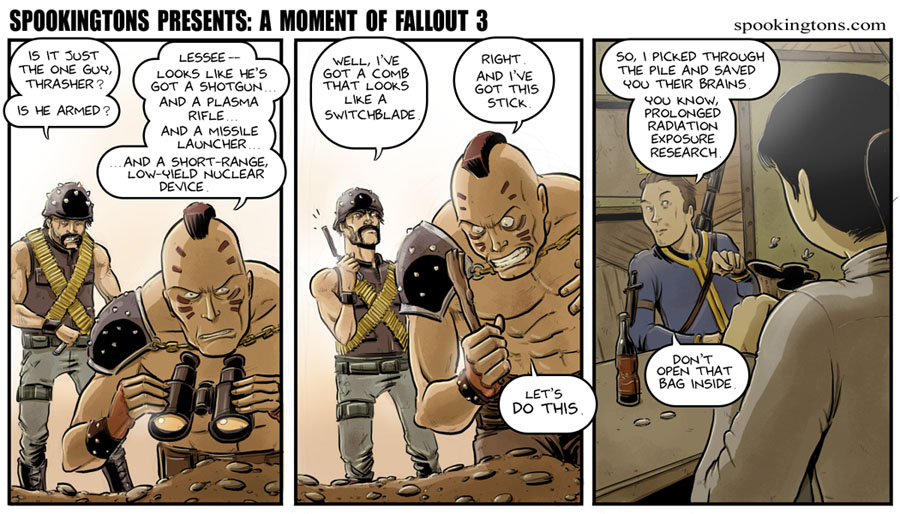
Your players are probably pretty strong. At level 1, maybe this isn’t quite as true, but chances are once your players get to level 4 or 5, there are going to be enough lower level, completely powerless (in comparison to your players) creatures out there that your players can completely massacre very, very quickly. If you’re going to have some interesting, random locations in your world, don’t be afraid to scale down the power level and make the encounters appropriate to the people living near the location, rather than the heroic players who happen to stumble across it. Let your players run wild with that. Let them go through the dungeon in less than an hour and wipe out all the goblins who inhabit the subterranean ruins. Then, when your players end up in town the next day, they can say that they purged the local threat without breaking a sweat and now the helpless farmers and housewives have something to thank your heroes for. Good stuff. Everybody’s happy.
You could flip this situation and have the encounters be brutally hard, but hard encounters, that your players don’t have a chance of completing, can be a problem for locations like this because you run the risk of derailing the campaign over nothing. If you have them look into some minor location, but fill that location with equal level, or higher level challenges, you are probably going to be spending several game sessions getting through it (unless you just have one solo creature of moderately high level).
So, go download some of 2009 or 2010’s One Page Dungeons and put yourself together a little book of random locations. If you can, try to throw some random locations in there that actually don't have encounters. Those can be just as, or even more, rewarding than combat locales. When you’re players are travelling, pull out a dungeon appropriate to the area and go from there. You won’t be disappointed if your players decide not to explore the location, but they might just have a really good time doing something that both you, and they, had never thought about doing.
Monday, February 28, 2011
Rating Player Skill in RPG's... How?

How does one exactly measure the "skill" of a RPG player? I am in some ways at a loss for exactly how to do this...
A lot of RPG's have a huge luck factor involved in them. It is part of the nature of the beast really. Because Pen and Paper games use dice, rather than some type of computer interface or video game console, there isn't an easily accepted way to talk about gaming skill in our hobby, but I did think up a few ways that you could potentially evaluate player skill using these frameworks below:
Powergaming Mentality
As a powergamer, I think one of the easiest ways that you could rate skill is through the effectiveness of your character, or your group, in dealing damage. This especially works well in 4e where party optimization has become the new power gamer craze in some respect. Don't just optimize yourself, optimize everyone else with you. Then, using this powergamer mentality, you have a pretty easy way to rate how well a character or group of characters perform.
How much damage did you do in the encounter?
How much damage did you take?
How many monsters did you kill?
How many players were killed?
How many rounds did the encounter last?
Answering questions like these gives a pretty easy way to evaluate how powerful a given group is. But, even if you are evaluating based on these rubrics, it is still difficult.
The Success Mentality
I recently read Revenge of the Iron Lich by Save Vs Death. The delve is very interesting in that it presents a tournament style rubric for scoring the players as they attempt to navigate a potent and dangerous dungeon. I thought that this was a really cool thing to have in an adventure/delve like this one, though it does seem like their scoring rubric is pretty intense. It would require a very hardy group of adventurers to go through a dungeon like that one. This adventure is part of a design methodology called fourthcore - a type of dungeon design created to challenge the living daylights out of a group of near mad players/PCs. I really like the methodology behind the design of this adventure as well as the actual adventure itself.
One of the core principles behind this success mentality it seems is rating skill of characters/groups based on their success or failure in performing certain tasks. Did they find the treasure? How far along the adventure did they progress? Did they defeat X? These questions get a little bit further away from each individual combat and instead look at player skill from a bit of a larger scope.
The Roleplay Mentality
I don't really know how well I could evaluate skill of a roleplayer in this area. Evaluating a player based on his or her abilities at roleplaying seems like I would be holding a little Oscars of my own right at the game table. I don't know if I would have the talent to judge a roleplayer based on this criteria. Might have to call in the Academy... the award goes to... Natalie Port... wait.... Jerome the Bard.
The problem with evaluating player skill based on a roleplay mentality is that you really can't do that. It would be impossible to provide any actual point based system for scoring or analyzing. To me, this mentality seems a little bit like a lost cause.
What do you think?
How would you rate a player's skill? Do you have a way to do it that is based on a single encounter rather than an adventure or delve?
Sunday, February 27, 2011
We need an RPG like this....
WARNING!! NSFW WARNING!!
I don't usually post stuff that isn't clean on my site, but this weekend, after hearing all the related news to the Video Game Bulletstorm I decided that I was going to have to have a go at the demo. I picked it up off of PSN and, well, it was amazing. The demo was really, really fun and I can only imagine that the full version of the game will be as well. I can't imagine how mad multiplayer in this game is going to be, but I am sure that it will be more fun than barrels full of monkeys.
Check out the trailer for the game below.
If you're not sold on the game simply from the preview trailer above, you should download a copy of the demo for the nex-gen console of your choice. It didn't last all that long, but I'll tell you a secret - If you play the demo, and finish it, you can get some cool stuff for the game when it comes out.
But, why do I bring all this up? Well, it kind of makes me wonder if we could put an RPG together like this. One that lives on a mantra like "KILL WITH SKILL!"
In my mind, that would be sweet. It might not be something that everybody would want to play, or something that you could run long campaigns of, but I think it would fall into the category of games for me, like the new edition of Gamma World. I would play it once in a whle and probably drink a beer while I play.
I don't usually post stuff that isn't clean on my site, but this weekend, after hearing all the related news to the Video Game Bulletstorm I decided that I was going to have to have a go at the demo. I picked it up off of PSN and, well, it was amazing. The demo was really, really fun and I can only imagine that the full version of the game will be as well. I can't imagine how mad multiplayer in this game is going to be, but I am sure that it will be more fun than barrels full of monkeys.
Check out the trailer for the game below.
If you're not sold on the game simply from the preview trailer above, you should download a copy of the demo for the nex-gen console of your choice. It didn't last all that long, but I'll tell you a secret - If you play the demo, and finish it, you can get some cool stuff for the game when it comes out.
But, why do I bring all this up? Well, it kind of makes me wonder if we could put an RPG together like this. One that lives on a mantra like "KILL WITH SKILL!"
In my mind, that would be sweet. It might not be something that everybody would want to play, or something that you could run long campaigns of, but I think it would fall into the category of games for me, like the new edition of Gamma World. I would play it once in a whle and probably drink a beer while I play.
Friday, February 25, 2011
Getting rid of Weapon and Armor Proficiency the Demon's Souls Way
Pretty much as soon as the announcement that Dark Souls was going to be coming out, I got out my copy of Demon's Souls that I had put away since picking it up at Christmas and decided to give it the play through that it deserved. I'm going for 100% trophy completion. That is not going to be an easy task, but it should sure be a fun one. Right now I'm about Soul Level 100 and about to finish my first run through of the game (that is only about 25 Hours of actual play time - I'm a quick one). The other challenge I set for myself was that I was going to play the entire game offline - nobody will be helping me on this solo path towards greatness. I will probably end up jumping online to PvP with people, but only because I'm a griefer who enjoys hunting and killing other collectors of souls. ;P

My current character, Azmodeous (gotta love him) is a bucket of fun for several reasons. One of those being that I decided I wasn't going to be taking him down a particular special road through the leveling process. Instead, I decided to keep him pretty well balanced and try to make him have as much options accessible as possible. He is turning out to be very mage-like, but he can swing one of the above big bad cloud swords like the best of them.
One of the reasons that is actually very easy in Demon's Souls is through the way that they deal with equipment and proficiency. In order to use a particular weapon, all you need is the requisite minimum statistics. There aren't any Feats you have to deal with, or any skills you have to train if you want to use something like a wand or a big huge sword. All you need is a bit of magic power or a bit of strength or faith and you're good to go. I love that.
In the course of leveling this character up, I have tried to stay very general in the advancement process, though I have been putting a few more points into some statistics than into other. I have tried to give him the ability to have as many magic spells as he can, as well as cast as many miracles as allowed (this game's equivalent of divine magic). Right now, I am almost maxed out in both of these areas. I can remember 5 of 6 possible magic spells and 3 of 4 miracles. This gives my character a lot of flexibility as to what spells or miracles he can cast when. Also, having both spells and miracles means that he has a pretty good balance of defense and offense making him a reasonably good PVE solo character.
But, spells and miracles are only half of it; there are also all the weapons. There are actually suprisingly more magic weapons in the game than I remembered. The reason for that is probably due to the fact that my first time playing through the game took me well over 200 hours. I got beaten down badly all the time. But, once you figure out the game, and get better at it, you learn to remember where things are difficult and where the bad things are going to come out of the darkness and the game's difficulty level becomes a bit more manageable. Because the game took me soooooooo long to play, I remember using the same basic gear for a much longer period of time.
But now, that is a very different story. I am going through weapons pretty quickly - I have gotten a bunch of new magical gear which keeps me entertained. And, since I'm kind of middle of the road when it comes to stats, I almost never worry about not being able to use something - being a generalist certainly has its perks.
Maybe the simulationist has a perfectly reasonable explanation for why certain weapons may require proficiency to use well, or why some weapons are harder to use than others, or why a certain weapon might require special training to be able to actually hit someone with, but in the end, that all just feels like a lot of dead weight to me. I don't want to have to tie myself down to using only Fullblades for the rest of my fighters career, when I pick up that Exotic Weapon Prof Feat at level 1. Retraining aside, I think it is much more fun to simply allow people, within reason of course, to use whatever weapon they want whenever they want to use it.
The way that Demon's Souls does this is pretty clean and simple. Every weapon has an associated set of abilities; maybe that is strength, or dexterity, or maybe it is faith, magic, or luck. If you don't have the requisite ability score, you can't use that weapon to its full power. You suffer some damage when wielding the weapon in question. Most of the time though, weapons that are in the same category all pretty much use the same ability scores as a baseline. If you're going to be hitting someone over the head with a big sword, you will likely need a high strength; the same can be said for medium sized swords, and other two handed weapons as well. By doing this, the game allows you to pick from a lot of different weapons, keeping the game fun, and also keeping you from getting bored. Variety is the spice of life and this system keeps life very spicy.
You could easily make whatever pen and paper RPG you are playing work the same way. D&D 4e is particularly easy in this respect. For example, you could simply rule that anyone with a strength of 18 can use a two-handed weapon and gain the proficiency bonus for it. You could also say that 16 is required for things like axes; maybe 14 for stuff like one-handed swords, etc. House ruling like this will let your players experiment with different types of weapons and will allow them the flexibility to pick up something new once in a while and try it out.
Monday, February 14, 2011
Joining Eye of the Vortex - Staff Writer Extraordinaire

So, what will I be doing for Eye of the Vortex?? One might ask that question. One might assume that since I write a lot about pen and paper RPG’s here on this blog that I might be doing the same thing over there, but, if you thought that, you would be horribly, horribly wrong. I think I pretty much have the RPG front covered here and I haven’t really written much about my other hobby too much, unless I’m talking about it within the context of RPG’s.
This other hobby, you might ask, is video games.
I am a huge gamer. Video games are where I got my start. Remember, I’m a youngin. So, video games were my intro drug into the entire world of RPG’s, CCG’s, War Games, etc. So, when I heard that Eye of the Vortex was looking for somebody to write about video games, I jumped at the chance. If, for nothing else, the folks that write over there, and read the Eye of the Vortex would probably appreciate my yearly wrap-up of Tokyo Game Show a whole lot more than most of the folks here, who probably aren’t too interested in what games happen to be coming out in Japan and the status of next gen console gaming.
So, as of this week, I’m now a member of the staff over there. I still haven’t made my first post yet, but you can bet that when I do, I’ll make some kind of post about it here as well. Give it a read through and check it out, if you are so inclined.
Tuesday, February 8, 2011
Design & Development: Demon's Souls Pen and Paper Clone - Leveling and Gear P.1
In my continuing quest to build a Demon’s Souls-esq. D&D 4e module (mod) I have been examining more closely the way that Demon’s Souls deals with things like leveling up and equipment. And I think I have come to some interesting conclusions about how I would make it work.
First of all, the leveling system in Demon’s Souls is freeform and is much more like a point-buy system than the traditional D&D style leveling system. There is no level cap in the game (that you are going to reach quickly at least – I spent more than 300 hours playing the game, but I only got to like level 150 or so, the max level cap is around 990). Leveling up consists of spending soul points on a new attribute. The number of times you have done this is called your soul level – so, if I spent 50 points on leveling up my strength, my Soul Level would be 50. There are about 10ish attributes (going off the top of my head right now) which cover things ranging from your ability to dodge, carry more weight, take damage/block, and of course your power in casting spells, using bows, and hitting with big blunt/sharp objects.
In terms of Equipment, Demon’s Souls takes a very, very basic and primordial approach to gear. What you get in your starting package (i.e. the class you pick at character generation which amount merely to your starting stats, spells, and items) is going to be with you for a long, long time. You don’t find magical items of any kind until well into the game. I was often very happy just finding a new piece of better armor in a level. Collecting armor sets becomes one of the main attractions of the playing through various levels, but these armor sets aren’t really magical so much – they are just more efficient types of armor. Finding a set of full plate is a major pain. Finding good sets of leather is also very problematic. Also, finding weapons that have particularly good properties can be very difficult. I remembered that I was super pumped to get a Katana as a rare drop because it’s a fairly fast and high damage sword. The spear, which is one of the better weapons in the game (in my opinion) was also a pain in the butt to get my hands on.
Although you don’t find many magic items in the game, there are some that you get toward the end. You can also pick up a few magical trinkets which add to some of your abilities or do certain special things. The Rings that you pick up possess the most value to your character – they provide a myriad of bonuses to things such as your mana regeneration and your carrying capacity and the like. However, one of the larger elements to the game is in crafting and forging better more powerful versions of the weapons you start with. You can level a weapon up to level 10 (I believe), but that is going to take a LONG time; there are only very limited quantities of every type of material in the game and it takes a lot of skill and timing to get these precious resources. One of the big cruxes of this system though is once your weapon gets a particular type of enhancement, you can’t give it a different one. You are stuck with that one and can only level up the weapon, adding to its damage or efficiency. You could compare this system fairly effectively with 4e D&D’s magic weapon system. You won’t find these weapons anywhere in the world, but you can make them if you put in the time and effort to find what you need to do so.
One of the ways that I want to go about making this module for Demon’s Souls D&D is through experimenting with the Inherent Bonus system that D&D sets up for games in which you have a very low magic level. Instead of letting the players simply gain these bonuses as they level up, I’m going to use a system where they have to buy them individually as they harvest Souls from their fallen demon enemies (think of residuum and its usefulness in crafting magic weapons in 4e). By doing this, you essentially turn the leveling up process into something akin to a point-buy system. Also, by using a method like this, you let your players gain those bonuses through a level, instead of only when they level up. I like that system a whole lot better than simply having to wait until you pick up your next level to get a benefit.
In creating this Demon’s Souls mod, I am also going to be very, very strict with what weapons and gear I allow my characters to either take at character creation or pick up through the game. In all honesty, I very well might do away with all of the Superior weapons all-together in the beginning of the game. When players do actually find a Superior weapon, they won’t need the feat to gain the proficiency bonus with it. They will be able to use it outright, which might give them some incentive to do some hunting.
Also, magic weapons are not going to be something that you can just pick up through adventuring. Players are going to have to explore certain areas and collect the needed resources to put a certain property on a weapon they are carrying. They will be able to do this through either personal crafting or the use of some named, godly forge-master who is their to aid them, given the proper souls and funding.
I’ll have more to talk about again soon in my Design & Development of this Pen and Paper Demon’s Souls clone. Hope you stay tuned to check it out.
 |
| It is going to take a LONG time before you're ready to take on one of those big fellas- I should know... |
First of all, the leveling system in Demon’s Souls is freeform and is much more like a point-buy system than the traditional D&D style leveling system. There is no level cap in the game (that you are going to reach quickly at least – I spent more than 300 hours playing the game, but I only got to like level 150 or so, the max level cap is around 990). Leveling up consists of spending soul points on a new attribute. The number of times you have done this is called your soul level – so, if I spent 50 points on leveling up my strength, my Soul Level would be 50. There are about 10ish attributes (going off the top of my head right now) which cover things ranging from your ability to dodge, carry more weight, take damage/block, and of course your power in casting spells, using bows, and hitting with big blunt/sharp objects.
In terms of Equipment, Demon’s Souls takes a very, very basic and primordial approach to gear. What you get in your starting package (i.e. the class you pick at character generation which amount merely to your starting stats, spells, and items) is going to be with you for a long, long time. You don’t find magical items of any kind until well into the game. I was often very happy just finding a new piece of better armor in a level. Collecting armor sets becomes one of the main attractions of the playing through various levels, but these armor sets aren’t really magical so much – they are just more efficient types of armor. Finding a set of full plate is a major pain. Finding good sets of leather is also very problematic. Also, finding weapons that have particularly good properties can be very difficult. I remembered that I was super pumped to get a Katana as a rare drop because it’s a fairly fast and high damage sword. The spear, which is one of the better weapons in the game (in my opinion) was also a pain in the butt to get my hands on.
Although you don’t find many magic items in the game, there are some that you get toward the end. You can also pick up a few magical trinkets which add to some of your abilities or do certain special things. The Rings that you pick up possess the most value to your character – they provide a myriad of bonuses to things such as your mana regeneration and your carrying capacity and the like. However, one of the larger elements to the game is in crafting and forging better more powerful versions of the weapons you start with. You can level a weapon up to level 10 (I believe), but that is going to take a LONG time; there are only very limited quantities of every type of material in the game and it takes a lot of skill and timing to get these precious resources. One of the big cruxes of this system though is once your weapon gets a particular type of enhancement, you can’t give it a different one. You are stuck with that one and can only level up the weapon, adding to its damage or efficiency. You could compare this system fairly effectively with 4e D&D’s magic weapon system. You won’t find these weapons anywhere in the world, but you can make them if you put in the time and effort to find what you need to do so.
One of the ways that I want to go about making this module for Demon’s Souls D&D is through experimenting with the Inherent Bonus system that D&D sets up for games in which you have a very low magic level. Instead of letting the players simply gain these bonuses as they level up, I’m going to use a system where they have to buy them individually as they harvest Souls from their fallen demon enemies (think of residuum and its usefulness in crafting magic weapons in 4e). By doing this, you essentially turn the leveling up process into something akin to a point-buy system. Also, by using a method like this, you let your players gain those bonuses through a level, instead of only when they level up. I like that system a whole lot better than simply having to wait until you pick up your next level to get a benefit.
In creating this Demon’s Souls mod, I am also going to be very, very strict with what weapons and gear I allow my characters to either take at character creation or pick up through the game. In all honesty, I very well might do away with all of the Superior weapons all-together in the beginning of the game. When players do actually find a Superior weapon, they won’t need the feat to gain the proficiency bonus with it. They will be able to use it outright, which might give them some incentive to do some hunting.
Also, magic weapons are not going to be something that you can just pick up through adventuring. Players are going to have to explore certain areas and collect the needed resources to put a certain property on a weapon they are carrying. They will be able to do this through either personal crafting or the use of some named, godly forge-master who is their to aid them, given the proper souls and funding.
I’ll have more to talk about again soon in my Design & Development of this Pen and Paper Demon’s Souls clone. Hope you stay tuned to check it out.
Friday, February 4, 2011
Shadows of thier Former Selves - Ghost PC's ala Demon's Souls
I like that idea a lot. One of the cool things about ghosts, at least in mythology, is the idea that the spirit refuses to pass on as long if it is leaving its work unfulfilled; I find that this would make a great hook for the players and provide a reason for you as the DM to turn your players into ghosts after they die, instead of simply killing them off. Let’s face it, your players are the center of whatever world you are playing in. They have some epic destiny that they are all headed for right from the get-go. So, why should they be allowed to die off?
Resurrection has been in RPG’s and video games for a long, long time, but playing ghost characters doesn’t seem to be nearly as popular. There are all kinds of mechanical problems that you have to deal with, especially with D&D 4e when you want to run a ghost as a PC, but, why not just ignore most of that?? I like what Demon’s Souls does with their ghost modes. You lose a bunch of maximum health and have penalties when you die in ghost mode, but those penalties are much less than those you would face by actually losing your real body and dying that way. If you dye while in any of the game worlds, you face a host of penalties including shifting the alignment of the world in a particular direction; if you get killed by another player, you might even lose stats because of that death, but dying in ghost form is just a speed bump. You simply need to go retrieve your body and reclaim the exp that is still hooked up to your corpse.
I think thematically, this fits really well with D&D characters. You have your destiny, it needs to be fulfilled, and not even death is going to stop you. 4e also makes it easy to implement something like the Demon’s Souls system – if your player dies, one round after he drops, let him rise up as a ghost. Make his or her max health equal to his or her bloodied value and maybe restrict them only to at-will powers instead of letting them use dailies and encounters and action points (hey, they did die); but, other than that, let them play as normal. Don’t let them walk through walls like Casper, and don’t let them possess people, but let them keep on keeping on. When the fight ends, a little spiritual jolt is enough to implant them into their body again and function, once again, as normal.
Try this method out and see how it goes. I think it might need some play-testing to make it fair (and balanced) but I think thematically, it could work fine.
This week, I mentioned that the Sequel to Demon’s Souls, Dark Souls, would be coming out in 2011 and I may have mentioned in a comment that I am working on something of a Demon’s Souls Pen-and-Paper based clone. That is one of the many side-projects for a campaign on my current to-do list (which just keeps getting longer and longer).
 |
| The Blue Dude is Dead... Ghost Form FTW |
One of the core ideas behind Demon’s Souls video game is the idea that death is not an end, but simply an obstacle to your character. When you die, your spirit leaves your body, you lose some of your max health and you get to go into the dungeon again as a ghost in order to retrieve your body and all of your lost exp.
I like that idea a lot. One of the cool things about ghosts, at least in mythology, is the idea that the spirit refuses to pass on as long if it is leaving its work unfulfilled; I find that this would make a great hook for the players and provide a reason for you as the DM to turn your players into ghosts after they die, instead of simply killing them off. Let’s face it, your players are the center of whatever world you are playing in. They have some epic destiny that they are all headed for right from the get-go. So, why should they be allowed to die off?
Resurrection has been in RPG’s and video games for a long, long time, but playing ghost characters doesn’t seem to be nearly as popular. There are all kinds of mechanical problems that you have to deal with, especially with D&D 4e when you want to run a ghost as a PC, but, why not just ignore most of that?? I like what Demon’s Souls does with their ghost modes. You lose a bunch of maximum health and have penalties when you die in ghost mode, but those penalties are much less than those you would face by actually losing your real body and dying that way. If you dye while in any of the game worlds, you face a host of penalties including shifting the alignment of the world in a particular direction; if you get killed by another player, you might even lose stats because of that death, but dying in ghost form is just a speed bump. You simply need to go retrieve your body and reclaim the exp that is still hooked up to your corpse.
I think thematically, this fits really well with D&D characters. You have your destiny, it needs to be fulfilled, and not even death is going to stop you. 4e also makes it easy to implement something like the Demon’s Souls system – if your player dies, one round after he drops, let him rise up as a ghost. Make his or her max health equal to his or her bloodied value and maybe restrict them only to at-will powers instead of letting them use dailies and encounters and action points (hey, they did die); but, other than that, let them play as normal. Don’t let them walk through walls like Casper, and don’t let them possess people, but let them keep on keeping on. When the fight ends, a little spiritual jolt is enough to implant them into their body again and function, once again, as normal.
Try this method out and see how it goes. I think it might need some play-testing to make it fair (and balanced) but I think thematically, it could work fine.
Thursday, February 3, 2011
Dark Souls - The Sequel to Demon's Souls Announced... YES!!!
Well, you know how I have talked about this one particular PS3 game for a long time on this blog... yea, I'm talking about Demon's Souls - my favorite PS3 game, and among my top favorite games of all time. Well, the day that we have all been patiently waiting for has finally come. From in conjunction with Namco-Bandai has announced the upcoming sequel to Demon's Souls - Dark Souls. It looks awesome. I want to bring you the game trailer so you can bask in all of its awesome splendor. This deserves several cauldrons and a giant swimming pool full of WIN!
I have almost nothing bad to say about the original game. Sure, it was a bit grindy, but who cares. It was amazing. Give it a try and you will most certainly not be disappointed. I could write a guide to that game based on how much I have played it and exploited all the games secrets (yea I did the thing on 4-2 sooo many times that it made my bow and arrows scream and pain - if you played the game you know what I mean).
I can't wait for this to hit shelves. Usually, I don't pay premium price for video games. I tend to wait a year or two and pick them up for about 1/3 of the original price, but this one is going to be a buy-on-sight. Some people are complaining that they wish it was an exclusive like the first one was, but honestly, if it becomes a non-exclusive and through that this brand gets more attention and they make a 3rd/4th/5th game in the series I will spill tears of joy in such large quantities that rainclouds will get performance anxiety.
I have almost nothing bad to say about the original game. Sure, it was a bit grindy, but who cares. It was amazing. Give it a try and you will most certainly not be disappointed. I could write a guide to that game based on how much I have played it and exploited all the games secrets (yea I did the thing on 4-2 sooo many times that it made my bow and arrows scream and pain - if you played the game you know what I mean).
I can't wait for this to hit shelves. Usually, I don't pay premium price for video games. I tend to wait a year or two and pick them up for about 1/3 of the original price, but this one is going to be a buy-on-sight. Some people are complaining that they wish it was an exclusive like the first one was, but honestly, if it becomes a non-exclusive and through that this brand gets more attention and they make a 3rd/4th/5th game in the series I will spill tears of joy in such large quantities that rainclouds will get performance anxiety.
Wednesday, January 26, 2011
Now Playing: Magic the Gather... again... this time Online

When I worked at Fun 'N' Games in California, I used to pick up a fair amount of cards, but I was never the resident Magic Guru. We had another guy, Brian, who would usually run Friday Night Magic, or the tournaments on the weekends. I didn't do to much work with singles buying, but sometimes, when the other guy wasn't there, I picked up some cards that I knew we would sell... and sell we did.
The highlight for me as a Magic Player came around the time of the Guild Pact set. That was the only era of the game which I have actually played hardcore. I picked up a couple boxes of packs and was opening packs up just about every week. I played in several local tournaments and placed top 8 a few times, but that was never enough to win anything. I don't even think I ever got a DCI number... but, I had a lot of fun.
I think Draft has always been my favorite play format because the playing field gets nice and even. You don't have to worry about having a deck that loses because it isn't full of the best cards. I have never been one to shill out massive amounts of money for expensive, unbeatable decks, instead, turning to commons bins and friends with boxes of cheap cards in order to build fun, semi-competitive decks. I have had a few nice ones, which I loved, including a deck full of walls.
Among the gaming groups in Yamanashi, there are currently two groups that run D&D - one on Tuesdays and one that I run at my place once in a long while (unfortunately most of my players are running out of time on their contracts and are heading home pretty soon - bummer). But, there is also a recurring Thursday night MTG group that gets together for some casual play, running strange game formats and playing multiplayer. I have been to that group once since I got here and I am going again tonight. You'll note that I only had one post come up today because I have been busy... deckbuilding and getting MTG:Online Running on my netbook (that was a huge pain btw, but one 5 minute call to WotC customer service was able to get my account running in no time. Because of my small, tiny screen, the resolution changes make the activate new account button invisible... lame! that is something they might want to think about fixing at some point :P but, oh well. My fault for playing below the resolution requirements).
So, if you are a MTG:Online player and you want to get in a game with Greg the Minotaur, feel free to friend me and follow me on Twitter. They both use the same screen name. My SN is Shinobicow776; you can follow me @Shinobicow776 using one of the buttons on the top of this here blog and then request games with me when I am offline. I will probably be online after work most days, when I am not working on RPG related stuff, so I should be easy to find. Go easy though. It has been a while. I'm very rusty.
Monday, January 24, 2011
D&D 4e Combat Modes inspired by Shooter Multiplayer

I am a video-gamer. I enjoy my PS3 on a daily basis and other than RPG’s, which you can pretty much figure that I love, I really like RTS games as well as shooters. I haven’t gotten a chance to play Black-ops yet, but I am a big player of Call of Duty: Modern Warfare 2. One of the great things that is offered in that game is a real plethora of game styles. I think a lot of those game styles would be very well suited for a game of D&D around the table rolling dice. Maybe you could think about running combat encounters in some of these shooter game based styles.
FFA/Team Deathmatch/Bloodbath
These are the typical encounters that you see in standard D&D games. The win condition for these type of games is simple – kill everything; the side with the most kills wins. With games like D&D, players aren’t likely to respawn in the middle of combat in order to continue the battle until the end of some imposed time limit, but they are likely to go until one side drops, this side is usually not the players unless your DM is a real jerk who has enough friends that his game can change players every week.
Capture the Flag
This style of combat is one of the easiest I think to run, but I don’t see it used nearly enough. One team has to capture the opposing team’s flag and bring it back to a designated point on the map. How easy would this be to run in a D&D game? C’mon. The flag doesn’t have to be a flag per-se. It could be anything from an enchanted skull, or some kind of magical text/tome. The battlefield itself, in an encounter like this might span an entire city. The players have to get into the enemy base, steal the object of importance, then get it back to the city guards before they are caught and captured by a group of Thieves sent to retrieve their stolen, stolen merchandise. This might be going on while at the same time another group is trying to move into the player’s base of operations and make off with something important of theirs.
Take and Hold/King of the Hill/Global Thermonuclear War
This type of combat forces the players/enemies to take and hold a certain point on the map for a set period of time in order to win the combat. I think this type of combat encounter makes for a great opportunity for some fantastic tactical combat. Each round that the players, and the players alone, occupy a certain zone on the map, they rank up a point. The players need to achieve 3-5 points in order to win the combat, but counter to that, if the enemies do the same thing, the players end up losing. I could see this in a D&D style game, by having the players attempting to defend a crucial ritual casting zone. Presence in the zone for a certain number of round allows direct communication with a player’s/enemies deity. Both sides want the zone, and the ability to talk with a god, but while the players are fighting over the zone, the ritual doesn’t know who to target, so it won’t proceed.
Shoot the Messenger/VIP
I don’t see this in games so much, but essentially this style of combat forces the players to attempt to kill a certain priority individual in a given amount of time, before that individual can either escape, or gain some critical power. I could see this style of combat being GREAT for D&D. The PC’s have been given critical advice that a messenger, carrying an important letter which will band two cults of Orcus together, creating a much larger and more formidable force. However, when the PC’s finally encounter the messenger, the realize that he is in disguise – all the individuals in the messenger’s party look and dress alike. The messengers, and his look-alikes all spit and run when they are confronted and attacked by the PC’s. Now, the players have to figure which one of the messengers is the real one and get him before he has a chance to slip out of their grasp and get away.
Search and Destroy/Sabotage/Bomb-Mode
In this style of combat, one side controls a “bomb” and has to plant it somewhere in the enemies territory, while the other side has to try and disarm the bomb or prevent it from getting planted in the first place. I feel like this style of combat could be very easy to pull off. The players might be on either side; I could see either one being very fun and interesting. Perhaps in one version of this combat style, the players possess a powerful relic which, when planted in the Necropolis somewhere, has the power of bringing down the light of Pelor (or some other random good deity) and destroying said Necropolis. The undead forces of this evil citadel come at the players in endless waves trying to keep them from detonating this relic. On the flip side of things, perhaps a group of cultists is planning to summon in demons somewhere within the PC’s stronghold or home city. The players have to scramble to find where this is taking place and then stop it from happening. You see this type of combat a bit in D&D, but now image if it is all done in initiative and your players have only rounds to stop it from happening. That might get them hopped up in their pants.
Snipes & Knives a.k.a. Limitation modes
This one goes back to CS. I like the idea of having limited power/weapon combats. Though these type of combats may ultimately be decided like the typical Bloodbath type of combat, they are interesting in that certain powers/combos simply don’t work in the combat itself. This one would be easy to implement, but might not be so fun for your players. Think about taking all their weapons/implements away and making them fight a combat or two bare fisted. Or, think about having everything for a day cost more effort. Maybe all of your players at-will powers become encounters, encounters become dailies, etc. This could lead to some interesting happenings. You could also think about magical barriers which prohibit certain types of magic from crossing them – that might get on a player’s nerves if you pick on a single power source. Or, maybe you want to make the entire combat done only with longbows, and have your players trying to snipe people from really, really far away. That could be fun.
What all of these different combat format options provide is a way for you to end combat in a failure, but not by killing all the players involved. You see this thought process in the way skill challenges are developed now. Those challenges provide the players with the pass to success, which, when achieved, grants the players a cleaner path to success in a particular adventure path, but failure does not mean the end of all things for the PC's. If you use these type of combat encounters, rather than the simple Kill or Be Killed Deathmatch style combats, you have the option of making failure much more interesting and having the results of failure mean that you end up with interesting roleplay encounters and more varied encounters to come. I hope that you take these ideas and roll with them in your games. I know I will.
Getting your inFAMOUS in my D&D 2
 Ok. I know. I made one post about inFamous already in the last week. Why write another one… well, there is so much of this game that I like, that I just can’t stop thinking about all the ways those good elements could be incorporate into my tabletop game.
One of the core elements in inFamous is the Good/Evil choice in relationship and the city you explore. Throughout the city, you are confronted with various quests in the side quest and main quest variety. Although the main quests help move the story along, there are tons of little side quest which you can do between these main quests which help to build your reputation in the city, or, break it apart.
I find a lot of the side quests in inFamous to be repetitive and lame. After clearing the 10th building of cameras, I pretty much hated that type of quest, but although I dislike the actual quests themselves, I do like what they do for you with respect to the game.
When you complete a minor side quest, you get some experience points and you lock down a section of the city. You essentially gain control of a single portion of the sandbox and prevent enemies from returning to that area. I like that mechanic a lot. Though it wouldn’t work very well with D&D, because there are not all that many random monster/fights you have in cities, I think there are several ways that you could make it work.
The other aspect of the side quests in inFamous that I like are the good/evil choice quests. You have an alignment in the game which effects what kind of powers that you can use. As your alignment goes more towards the hero side of the scale, people love you and want to take your picture. As your alignment shifts the other way, people start to fear you (though I am not sure exactly what happens since I haven’t gone that path in the game… yea… I became a goody two-shoes hero-boy). As you do these alignment shift quests, every good choice quest you complete locks out one of the villain quests. That is a great idea as well. I like it a lot.
I think there is an easy way that you could make these work in a D&D game. For each minor quest you complete, whether that be just breaking up a bar fight, or helping get someone’s cat out of a tree, your reputation in a particular part of the world increases or decreases. Every quest makes you more notable, but the way you conduct yourself in completing those quests, either through good means or evil ones, affects how the majority of people in the world see you. You could then easily make these quests connect to encounters; for example, if you were trying to be a good, law abiding citizen, and happened to clean up some of the scum of the city, the city guard might approach to either recruit or aid you. On the flip side, if you were constantly stealing horses and causing bar fights, you might get in trouble with the law, but seeing your potential, the local thieves guild might try to get you out of trouble in return for your service.
I also think that the city control aspect could be easily implemented as well. If you do more good quests, the presence of evil elements in a part of town might dry up, but go stronger in areas where you have not fought them before. On the other hand, if you happen to pressure the city guard enough, they might need to get out of the bad areas of town for fear of being over-run (or, you might develop enough power that you convince them through their wallets that not being in the slums is a good idea).
I like what World of Warcraft has done with its new quests system. It made them a lot of fun for players of all races and classes. Combining the style that inFamous does with its quests, with the content and variance of depth that you get in WoW quests, could make for a perfect pairing.
Friday, January 21, 2011
Getting your inFAMOUS in my D&D
I talked a little while ago how I would love to see a version of Demon’s Souls made as a table top RPG that uses dice. Demon’s Souls has got to be one of my favorite games for PS3 period. But, lately, I have been playing some other stuff. One of these “other” games that I am playing right now is Infamous. That came out a couple years ago, but like everything else, I am pretty late to the scene. If you haven’t tried the game yet, but have a PS3, I strongly encourage you to go pick it up for $20. You won’t be disappointed. It isn’t a game that would make me want a PS3 just from playing it, like Demon’s Souls was, but it is a game definitely worth giving a try.There is one aspect of that game that I think would be really cool to have in my D&D games. In Infamous, there is a collection mechanic which revolves around exploring the world and its tiniest minutia. In order to increase your total health and energy, you must travel around the world, exploring the city and collecting “blast shards”. What these shards are actually from is totally lost on me, but their purpose in the game is clear and two-fold: a) through them you are encourage to explore the sandbox, climbing buildings and exploring tunnels and b) they are there to help you and provide you a statistical, permanent bonus to your character.
This is a mechanic which I can get behind and I would encourage DM’s to do likewise if you have a big sandbox you want your players to actually explore. Looking at this mechanic, I went back to the old days in 3.5 D&D when you had all the tomes, which were crazy expensive, but when used, would permanently give you a bonus to one of your stat bonuses. These books were WAY more pricey than anything else in the game, but the benefit they provided could not be taken from you in any way, nor did it take up a slot on your body.
I am thinking that you could do something similar with these “blast shards” in D&D, Gamma World, or pretty much any other game out there. The key, I think, would be not to give it to the players all at once. In Infamous, you have to collect bucket loads of these shards in order to actually finally get that benefit, not only that, but the number of shards you have to collect goes up exponentially as you gather more. I think I have to get like 30ish more shards before I finally gain another energy bubble.
What I came up with for D&D, which may be stolen from an anime or something… I am sure I have heard about it before somewhere… is to have the players collecting pages of a book. Every time they complete a chapter of that book, i.e. collect a sufficient number of pages, they receive a boon. You could give the boon to everyone in the group and it wouldn’t matter all that much.
The problem that I see with this though is you don’t want to make these boons too powerful, or put too much emphasis on them for the story; if you do over-hype these pages, you risk the players ignoring your story in order to simply travel the world in search of all these pages (that might be a nice way to develop a major campaign, but not some minor quest which is simply a carrot to be waved in front of your adventurers in order to keep them moving and exploring a city or nation).
You could do something very similar with Gamma World. Hell, with Gamma World you could even leave them as blast shards and simply let them build up into gaining some new Omega Tech or some new Alpha Mutation.
Subscribe to:
Posts (Atom)